Research
The Watch That Feels It Before Your Child Does: Smart Sensors and the Autism Spectrum
22.08.2026 · medRxiv
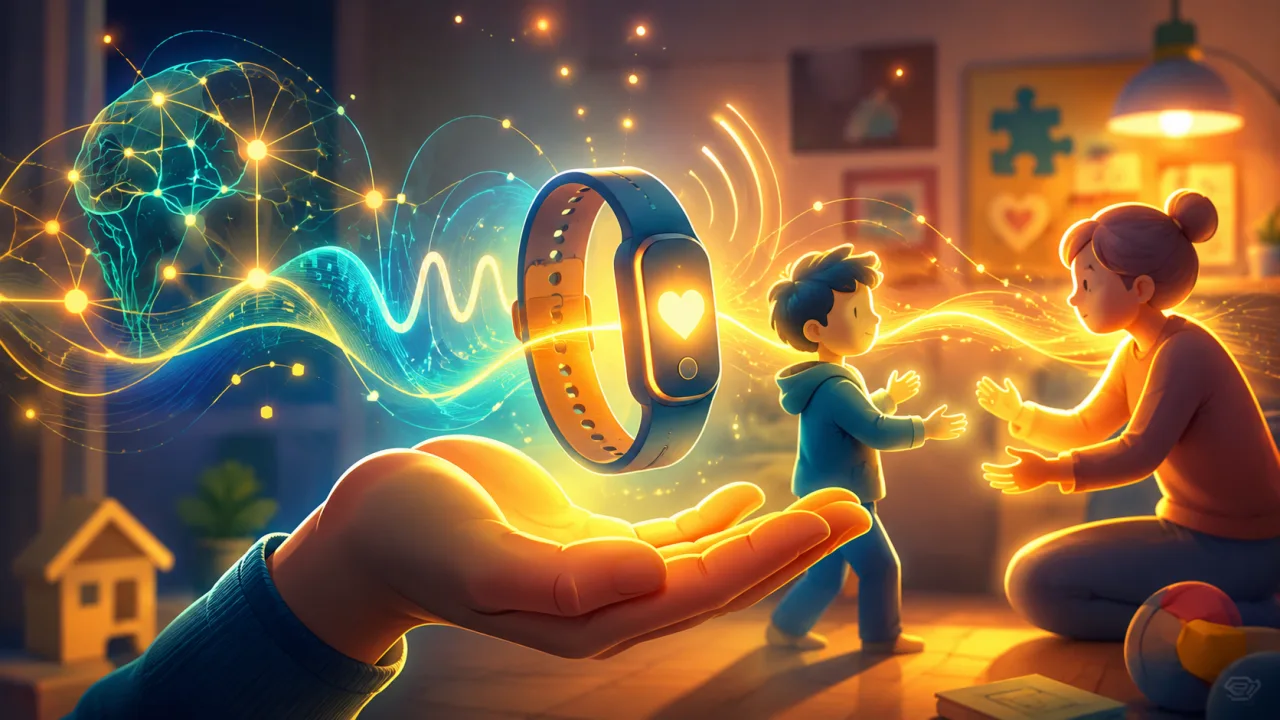
Every parent of a child on the spectrum knows that moment - something shifts, and you can't quite put your finger on what. Your child goes unusually quiet, or their movements suddenly speed up, and you sense a storm is already on its way. What if there were a device that could feel that storm coming before it even arrives? That's exactly what researchers have been exploring with growing intensity over the past year - wearable sensors that listen to the body.
A study published in May 2026 on the medRxiv platform examined, for the first time, four types of wearable sensors inside a real classroom - on the wrist, on the forehead, as a patch on the chest, and even as a ring on the finger. The sensors measured physiological data in real time - heart rate, perspiration, and movement - and attempted to identify patterns that precede moments of distress. A second study, published in Engineering Reports in early 2026, developed a personalized alert system tailored to each individual child - because what signals stress in one child can look completely different in another. This is one of the key innovations: the system doesn't rely on a single general model, but instead learns the unique body language of each and every child.
The idea is simple, even if the technology behind it is complex. The sensor is worn like a watch or bracelet, collecting data throughout the day and feeding it to an artificial intelligence algorithm - machine learning - that has been trained to recognize the child's personal patterns. When the system detects a change that predicts difficulty, it sends a quiet, discreet alert to the parent, caregiver, or teacher. This isn't "monitoring" in any frightening sense of the word - it's more like a close friend who knows you well and always seems to ask "are you okay?" at exactly the right moment. It's important to note that this field is still in the research stage and has not yet reached routine clinical use.
Families in Israel have a particular connection to this topic. As the website autism.org.il summarized in its June 2026 review on artificial intelligence and autism - waiting lists are long, resources are limited, and professionals are stretched thin. A tool that helps a parent understand their child more deeply - not as a replacement for a therapist, but working alongside one - has the potential to improve the quality of every single day. Some of the devices being studied are commercially available for purchase today, though using them in a therapeutic context does require professional guidance.
At AUTIFACE, we believe that any tool that strengthens the bond between parent and child - that makes it possible to understand more, respond better, and be there at the right moment - is a tool worth knowing about. Technology doesn't replace love, intuition, or the knowledge you've built up about your child over the years. But sometimes it can give that love a few more tools to work with.
What this means for you
Smart wearable sensors may help parents and caregivers identify moments of distress earlier and respond in a calm, precise way - reducing the overall burden on the entire family.
Source: medRxiv