General
The love of people on the spectrum is real - we were simply taught not to see it
14.08.2026 · AUTIFACE
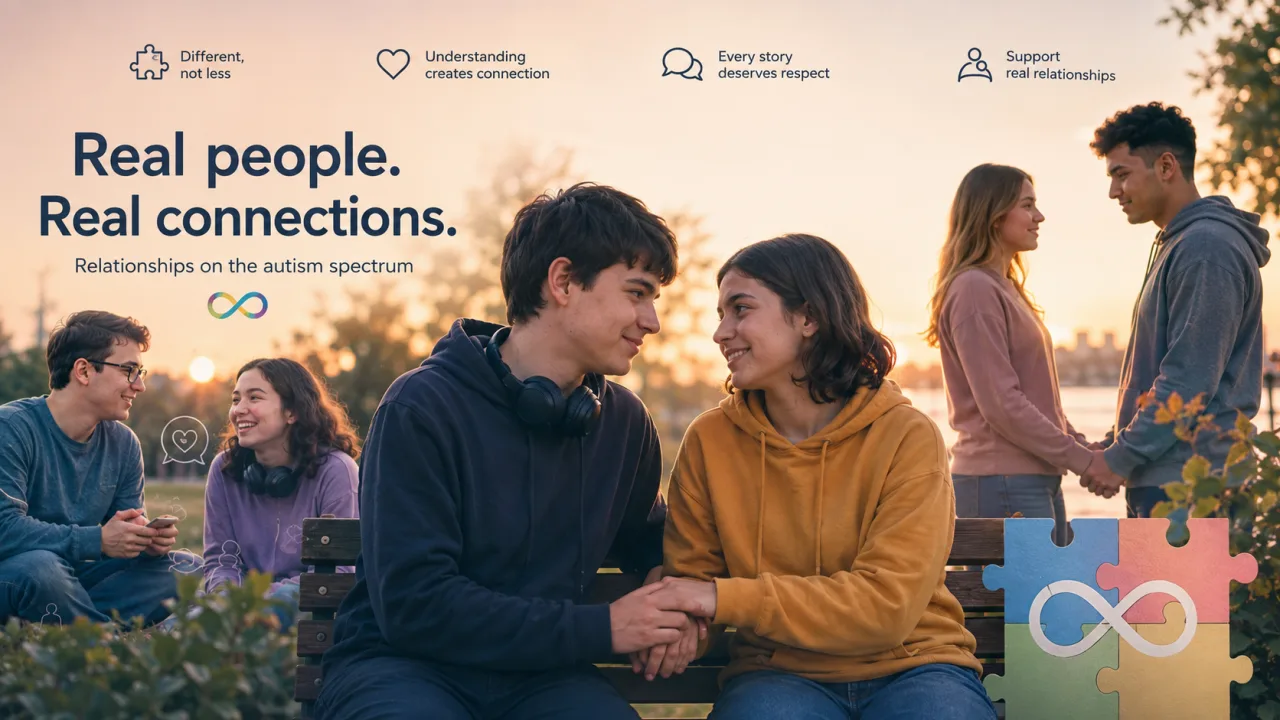
Think about it for a moment. When was the last time you imagined someone on the autism spectrum simply being in love? Not a child who needs therapy, not someone who needs to be protected, but someone agonizing over what to wear before a date, eagerly waiting for a text message, their heart racing when they see someone special. Hard to picture? That's exactly the point. Not because that love doesn't exist, but because we were taught not to see it.
There is a quiet thought that follows people on the spectrum throughout their lives, and it is almost never said out loud: that they aren't really looking for love, or that they simply aren't built for relationships. Nobody says it directly, but it hangs in the air. In the glances. In the fact that someone has already decided for them that it's "not for them" - without ever asking.
And the truth is the complete opposite. The desire for love, for closeness, for touch, for feeling wanted - has nothing to do with autism. It is human. A person on the spectrum wants to love and be loved just as much as anyone else. The gap between desire and reality is almost never found in the person themselves, but in the wall we built around them without even noticing.
Where the difficulty really begins
The difficulty begins with rules that nobody teaches us openly. From a young age we absorb how a relationship is "supposed" to look. How to court someone. When to touch. How to understand what the other person is feeling without them saying a word. None of these things are taught in school - they are simply soaked up from movies, songs, from what we see around us. But for a person whose mind takes in the world a little differently, these unwritten rules are like a maze without a map. And when someone doesn't behave exactly according to expectation, it is far too easy to label them as "cold" or "not interested," instead of understanding that they simply speak a different language.
A layer we don't talk about enough
There is another important point here. Many people on the spectrum, and especially women, learn from a young age to "mask" themselves. To imitate social behavior, to smile in the right places, to appear "fine" even when it feels completely different on the inside. This is called masking, and it comes at an enormous cost of exhaustion and stress. And when it comes to relationships, this masking can make a person especially vulnerable. They invest enormous energy in appearing to be "what is expected," and sometimes find themselves in unhealthy relationships just to avoid being alone, or because it is hard to recognize when someone is crossing a boundary. That is precisely why it is so important to talk about this openly, and to give people on the spectrum the tools and confidence to know their own boundaries.
The advantage nobody talks about
And right here lies a secret that many couples would be thrilled to discover. Many people on the spectrum communicate with a directness that others can only dream of. No games. No guessing. No "if she didn't reply within an hour it means...". Things are said as they are. Honesty isn't a tactic - it's the default. Think about how many misunderstandings and arguments all of us would be spared if everyone spoke that way.
So what is actually missing
Not the desire. And not the ability. What is missing is the environment. The more there are frameworks that understand, respectful support, adapted relationship education, and fewer whispers behind closed doors, the more people on the spectrum will receive a real opportunity to love at their own pace and in their own language. And it starts with one small change. Instead of asking "are they even capable of loving," we should start asking a completely different question: how do we make room for them.
What this means for you
If you are a parent of a child, a daughter, or an adult on the spectrum, the greatest gift you can give them is simply not deciding in advance. Don't assume that relationships aren't relevant to them, and don't rush to "protect" them from the world of connection. Instead, talk with them. About emotions, about boundaries, about closeness - in simple, clear language and at eye level. Let them understand that they are allowed to want love, and that they deserve to find it. The right to love and be loved belongs to every person, and that understanding begins in your home.